Monday, 20 August 2012

Back on the Farm

We interrupt the travelogue to describe life back in Ibaraki prefecture. I described the beginning of summer in a BLOG entitled "It begins". We left for Hokkaido soon after that where the temperatures could be as much as ten degrees Celsius cooler. So what was waiting for us here was a bit of a shock. Yesterday Monday August 20, 2012 the temperature in the family room climbed to 37°C before we gave in and turned on the room air conditioner. This brought things down to a cool 28°C. The skies are blue, the sun is a furnace and there is no rain on the horizon. I have not seen the "hatake" or fields so dry before.
On Sunday our first full day back we took it easy all day. Shigeko Okano brought us cold tea and "suika" or watermelon grown here on the farm. It was quite delicious and apparently the crows agree with our assessment. Another novelty we have been eating since we got back is the cucumber like "goya" fruit that grows on vines shading the windows from the sun. The plant originates in Okinawa, but can now be seen even in Hokkaido. The green coloured fruit as seen in the photograph has many protrusions on the surface and the taste is quite bitter, but edible. The cucumbers and a bit of corn that we enjoyed prior to the Hokkaido trip is finished. The only thing still producing from three weeks ago are the tomatoes and "nasu" or eggplants.
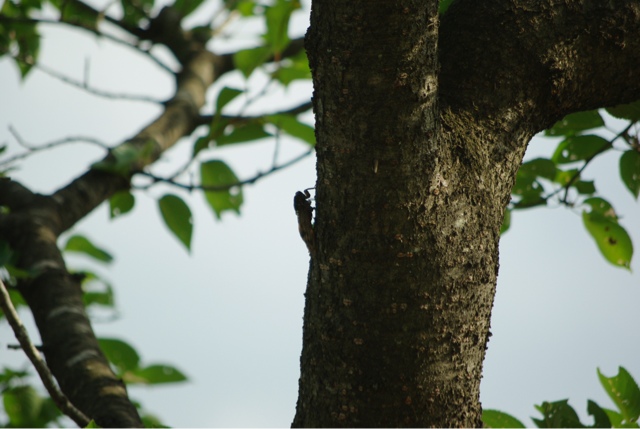
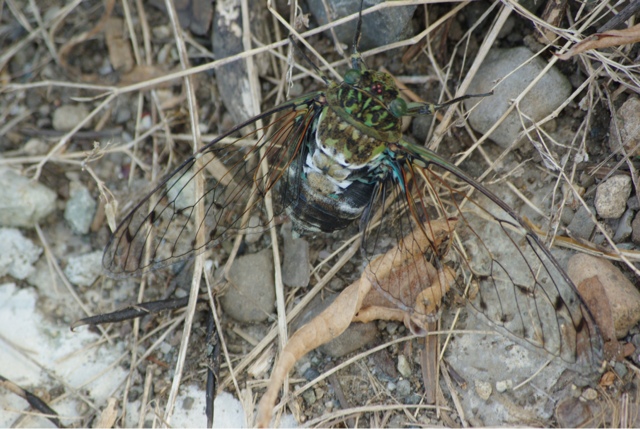
I always said I wanted to live in a more tropical climate, but now I am not so sure. I am beginning to understand how heat can take away all of ones motivation and ambition. Akio Okano still puts in a days work, but I have drastically changed my schedule. Yesterday and this morning I got up at about 0445h and was at war killing weeds at about 0500h. I work while the sun is coming over the horizon and it already feels hot. This morning I came back before 0700h and walked my buddy Muku. Today one of his girlfriends across the road happened to be "loose" and came walking with us. I don't know how the dogs can stand the heat, but there is nothing they love more than a walk or should we call it a 'sniff around'. Probably the most pronounced clue that summer has arrived is the sound of "semi" or cicadas. We have been told that there are about four varieties of them in Japan and each one has a different song. In fact they are so loud you might think a 'semi'-trailer is about to drive through the house. Muku previously liked nothing more than walking the edges of the "tanbo" or rice fields finding and eating (usually dead) crayfish. Cicadas are quite a large insect and when there tasks are done, they die. Well of course, Muku is not too fussy about what he eats, so now he spends most of his time walking sniffing for cicada carcasses. This morning he almost ignored his girlfriend. Two of the photographs are of cicadas, one just a profile on the tree trunk and the other a colourful one that landed in front of us in preparation for death.
Akio Okano mentioned that this coming Saturday, the town of Edosaki will be putting on a "hanabi" show or fireworks. As mentioned before we are close to ten meters higher than the plains below and can see Edosaki in the distance. Akio noticed that people were already putting in stakes and ribbons to reserve strategic sites for viewing so he decided he had better do the same.
Nikka Whisky

Most people in Japan would associate whisky with the Suntory brand name, but I will never forget more than thirty years ago being told by the husband of Yayoi's cousin that 'Super Nikka" being much superior to Suntory. Maybe Japanese Scotch whisky is better than Scottish Scotch whisky ;)
Anyway the August 2, 2012 factory tour highlighted typical Japanese ingenuity. The founder of Nikka went to Scotland many years ago to learn how to make whisky. As so often happens a Scottish lass attracted his attention and they became married and both went to live in Hokkaido where they set up the Nikka whisky factory. Some of the buildings on the grounds demonstrate a Scottish influence in their design.

Click on Nikka Factory to see photographs on Picasa.


Lake Toya and Usu Mountain in Hokkaido

On August 1, 2012 Katsuo and Sumiko took us to see a number of well known Hokkaido tourist sites.
Lake Toya is a roughly circular lake with a number of islands in the centre as though "the creator of all" loved Japanese gardens as well as many people do. But in Japan you dare not take anything for granted. In 1977-78 and in 2000 Usu Mountain nearby decided to announce its presence with some fireworks. The building shown is a mansion (condominium) which had occupants, but the destructive effects of the volcano put an end to that. The dam in the photographs was built to block future mud flows. Two of the photographs demonstrate another mountain that is quite active spouting steam.

Click on Lake Toya and Mount Usu to see photographs on Picasa.

Sunday, 19 August 2012

Hakodate

Like Sakata on Honshu, Hakodate is a seaport, but while Sakata appears to be a sleepy city, Hakodate is quite a bustling place. It is famous for its ika or squid and early in the morning many touristy restaurants near the waterfront serve a variety of fresh (of course raw) seafood. We arrived in this city midday of July 30, 2012, but did manage to find one place that still had some food left at four in the afternoon.
In the evening we walked to Hakodate Ropeway and took it to the top of Hakodate Mountain. Here the city lights situated on a narrow peninsula with the Pacific Ocean on both sides could be seen. We also noticed some very bright lights further out on the water. Later we were told that these were probably the extremely bright lights used by squid fishermen to attract and then net them.
In the morning we took a streetcar to an observation tower from which the city could be seen as well as the remains of the huge pentagonal star shaped Fort Goryokaku. This city is the site of the last stand of the pro-Tokugawa forces against the Meiji Restoration that took place in 1868. Interesting that not long after the war the winter ice forming in the fort's moat was harvested and sold in Honshu as Goryokaku Ice.

Click on Hakodate to see photographs on Picasa.

Honshu to Hokkaido Seikan Tunnel

The tunnel is 53 kilometres long under the ocean which is 23 kilometres wide at this point. The tunnel is 240 metres below the surface of the Tsugaru Straits and the water is 140 metres deep at the deepest point above the tunnel. It takes the train about 24 minutes to traverse this tunnel and the ride is very smooth. It feels like a jet floating in the sky. Currently there are no "shinkansen" or bullet trains on Hokkaido, but there are plans to have the shinkansen replace the current express trains.
There are countless tunnels in Japan, mostly beneath mountains and many of them were originally built using manual labourers, resulting in significant losses of life.
The first photograph is Honshu, the chart was on each train seat and the other two photographs are of Hokkaido. Notice the very simple style of the houses.

Neputa of Aomori Prefecture

Neputa of Aomori Prefecture
These are gigantic paper lanterns stretched over a bamboo framework, although apparently metal is also being used to alleviate fire hazards. They were originally lit with candles, but these have been replaced by electrical lighting. Although somewhat gaudy in appearance at first glance, the craftsmanship and artistic ability involved is quite remarkable.
In 1944 and 1946 there were two large fires that destroyed the blueprints of how to make the neputa. It was thought that all knowledge of how to reproduce the neputa had been lost, but in 1996 some photographs and blueprints were found and since then artists and craftsmen have been busy recreating the neputa.
The museum housing the neputa of the photographs is four stories high. Tourists are taken to the top floor by elevator and can then circle the neputa down to the ground floor. At one point the walkways can be moved out of the way to allow the neputa to exit the building and be pulled up the streets during the yearly festivals. The people of Aomori are very proud of their neputa and facilities housing them can be seen in many places in the prefecture.

Click on Neputa to see photographs on Picasa.


Saturday, 18 August 2012

Mate Hime Jinja or Shrine

Yayoi and I are trying to learn how to function with the variety of people we meet. We don't suggest what kinds of food we would like to eat as then we are treated to delicious treats we may not have encountered before. We try to keep our suggestions as to what we would like to see to a minimum for similar reasons. We would like to say that everything we eat is the most delicious thing we have ever eaten, but the problem with that (even if true) is that the people we encounter then buy these things for us and our luggage becomes even heavier. Point at something on the shelf and say it is tasty and five minutes later the package is in your hands.
Anyway on July 28, 2012 Noriko asked me whether she could show me a Shinto shrine in Hirosaki she is apparently quite proud of. I have seen many shrines, but if she was proud of this one I had to agree to go.
We drove to her medical clinic, parked the car at which point she pulled out a pair of heavy rubber boots for me to wear. Oh, oh, what kind of a shrine is this? We walked up the street to a dilapidated looking property. Noriko explained how the shrine had trouble maintaining itself and as a result had been selling land around the shrine to raise money. Eventually even this was not enough and possibly soon the shrine itself will be demolished. People normally only see the front end buildings of a shrine and this is apparently where Noriko and Soroku were married many years ago. This last winter there were heavy destructive snow falls and they succeeded in damaging the fence surrounding the building behind the front end building. This is essentially a holy place that only priests would normally see or enter. Wearing our boots we were able to get through the fence and see this special old wooden building. Old wooden buildings in Japan are frequently built without the use of metal fasteners. Noriko has taken many photographs of this building in an attempt to preserve its memory.
Mate Hime actually refers to Princess Mate, of the ruling Tokugawa clan who was sent to Hirosaki to marry the local lord or "daimyo". Although I am unsure of the details she was the second wife of Tsugaru Nobuhira and some sort of tragedy ensued.

Click on Mate Hime Jinja to see photographs on Picasa.